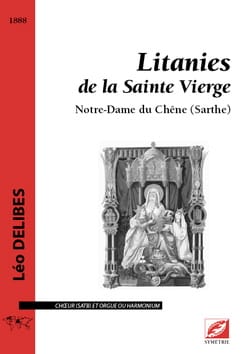
When he left his native Sarthe to settle in Paris in 1848, Léo Delibes (1836-1891) trained at the Conservatoire while being a choirboy at the Madeleine. A few years later, he was organist at Saint-Pierre de Chaillot and at the Saint-Jean-Saint-François church before joining the Théâtre-Lyrique and then the Opera as a choirmaster. Delibes then led a prolific career as a composer of operettas, comic operas or ballets, some of which enabled him to reach posterity (Coppélia, 1870 - Sylvia, 1876 - Lakmé, 1883). Member of the commission for teaching singing in the schools of Saint-Denis and Sceaux, he also leaves many choral pieces, including a brief Mass, for children's voices or orphons. In the Durdilly edition, the litanies of Delibes bear the title "N.-D. du CHENE (Sarthe) "Marian shrine located next to Saint-Germain-du-Val where the composer was born. They adopt a writing with four voices doubled largely by the organ. Higher voices, perhaps conceived for children, are first expressed with restraint (Sancta Maria) before being joined by those of men (Ora pro nobis). The whole room is bathed in a climate of fervor and sweetness, Delibes having excluded the Kyrie, who opens the litanies, and the Agnus Dei, who closes them, to enhance the maternal figure of the Virgin. Siba Sousou, under the scientific direction of Jean-Christophe Branger and Nicolas Moron

| |
 |